
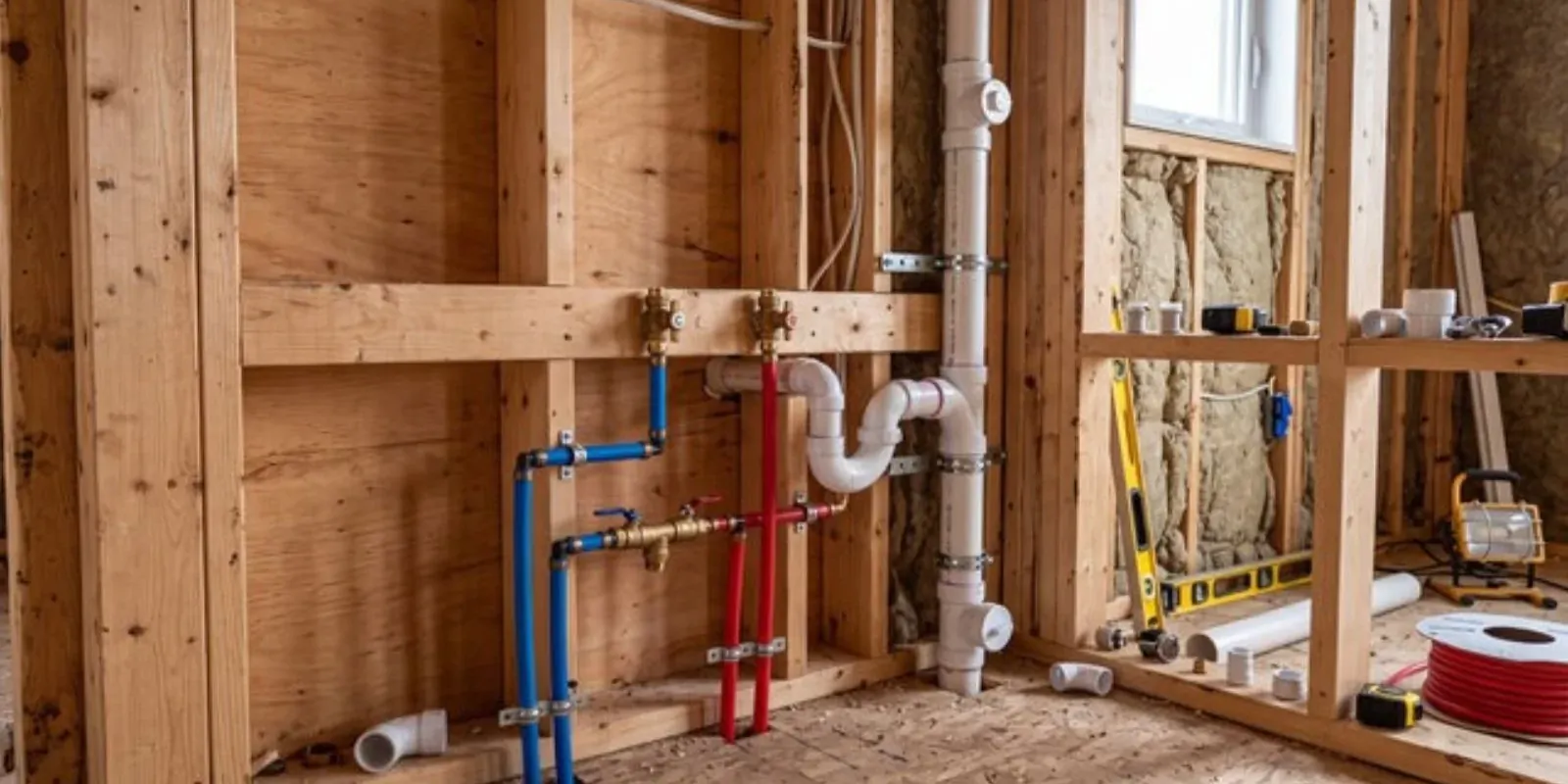
The four plastics and where they belong
Each has a role.
| Pipe | Use | Color or sign | Limit |
|---|---|---|---|
| PVC | Drain, waste, vent and cold supply where permitted | White, rigid | Not for hot water |
| ABS | Drain, waste and vent | Black, rigid | Not for pressure supply |
| CPVC | Hot and cold supply | Cream or light yellow, rigid | Brittle with age or high heat |
| PEX | Hot and cold supply | Red, blue or white, flexible | Not for sunlight or flue contact |
Drain pipes: PVC and ABS
Both carry waste by gravity. ABS is black and common in many parts of California, and PVC is white. They use different cement, and joining one to the other needs a transition fitting and the right cement. Mixing materials with the wrong cement is a cause of drain leaks.
A drain that is part cast iron and part plastic is common in renovated buildings. The transition uses a rubber coupling with stainless bands. If a coupling is loose, it leaks at the join.
Supply pipes: CPVC and PEX
CPVC is rigid and takes solvent cement. It handles hot water but becomes brittle as it ages, so a CPVC system in an older building can crack at fittings. PEX is flexible and tolerates movement. We cover the details in the post on installing PEX plumbing.
Neither is a good choice for gas, and neither belongs in direct sunlight. Both need proper supports and clearances.
How to tell what you have
Check these places.
- Look at the colorWhite, black, cream and red or blue point to PVC, ABS, CPVC and PEX.
- Read the printingPipe is stamped with its type and rating.
- Check under the sinkVisible drain and supply pipes tell the story.
- Ask your owner or managerBuilding records may list the material.
Why old pipes matter more than new plastic
Plastic pipes rarely cause trouble early. Problems come from the older materials around them. A building with a plastic remodel in one unit may still have cast iron stacks and galvanized supply in the walls. The joins between old and new are where leaks begin.
If you see a mix of materials, ask a plumber to look at the transitions. A camera inspection shows what is inside a drain you cannot see.
Plastic pipes and fire, heat and sun
Plastic softens with heat. CPVC tolerates hot water but not a flame, PEX should stay away from a flue and PVC should never carry hot water. Water heater connections normally use a short section of copper or a rated flexible connector between the tank and plastic pipe.
Sunlight damages PEX and weakens other plastics over time. Pipe that runs along an exposed garage wall or past a window needs a cover or a different material. If you see chalky, faded plastic outside, plan to replace it.
Which plastic for which job
A quick reference for owners.
| Job | Common choice | Why |
|---|---|---|
| Toilet and sink drain | ABS or PVC | Rigid and low cost, glued joints |
| Hot and cold supply in walls | PEX or CPVC | Rated for pressure and heat |
| Under-slab supply | PEX or copper | Needs protection and a sleeve |
| Vent through the roof | ABS or PVC | No pressure, light weight |
What to do if you find an unknown pipe
Read the printing on the pipe, which usually lists the material, the size and the standard it meets. Take a photo and bring it to a plumber. Mixed systems from different decades are normal, and the mix itself is not a problem if each joint is made correctly.
The thing to look for is a transition between materials. Those joints are where leaks start, and where an old fitting meets a new pipe. A plumber can check each one and tell you which are fine and which deserve attention.
Buying and joining plastic pipe correctly
Each plastic has its own cement or fitting. PVC cement, ABS cement and CPVC cement are not the same, and the wrong one can leave a joint that looks sound and leaks under pressure. Primer matters on PVC and CPVC, and the pipe must be cut square and cleaned before joining.
Look for the markings on every length, including the standard it meets, the size and the intended use. Pipe stored in the sun can be brittle before it is installed, so buy fresh stock and store it in the shade.
If a project mixes materials, ask for the right transition fittings, not a hardware store workaround. A transition that is rated for both materials lasts for decades. One that is not often leaks in months.
A note on warranties and listings
Plastic pipe and fittings carry listings that show which standard they meet and where they may be used. A fitting without a listing, or a pipe used outside its listing, can void a warranty and fail inspection. Keep the packaging or take a photo of the markings before you cover a run.
What shapes the cost of changing pipe materials
The scope sets the price.
More fixtures and floors mean more material.
Open walls cut labor.
Old to new joins need special fittings.
Replacing drain or water piping needs one.
Wall repair is separate.
Insurance does not pay for a material upgrade. It may cover damage from a sudden failure.
What this means for West Hollywood buildings
West Hollywood rent stabilization covers buildings with an original certificate of occupancy before July 1, 1979. In those buildings the supply may be galvanized or copper, the drains may be cast iron or clay, and plastic is often a later repair. Plastic in an old building is a clue that a section was replaced, and the age of that repair tells you what may be next.
The California Plumbing Code governs which plastics are allowed where, and local code adds permit rules. Ask the city before replacing piping. Our repiping page explains whole-building replacement, and the Hollywood page and Hollywood Hills page cover the neighborhoods we visit.
Local questions answered
Pipes rated for potable water, such as CPVC and PEX, are safe when installed properly. Drain plastics like ABS are not for supply.
Yes, with the right transition cement or a rubber coupling. The wrong cement leaks.
Not automatically. An old brittle system with repeated cracks is a candidate.
Black rigid drain pipe is usually ABS.
Sources and standards
Facts and rules on this page come from the public sources below. Check them for the current wording before you rely on a detail.
- California Plumbing Code (Title 24, Part 5), which is based on the Uniform Plumbing Code (UPC) published by IAPMO.
- City of West Hollywood rent stabilization rules, which cover properties with an original certificate of occupancy before July 1, 1979.
Got a plumbing problem in West Hollywood? Call the line.
Call (213) 672-5590