
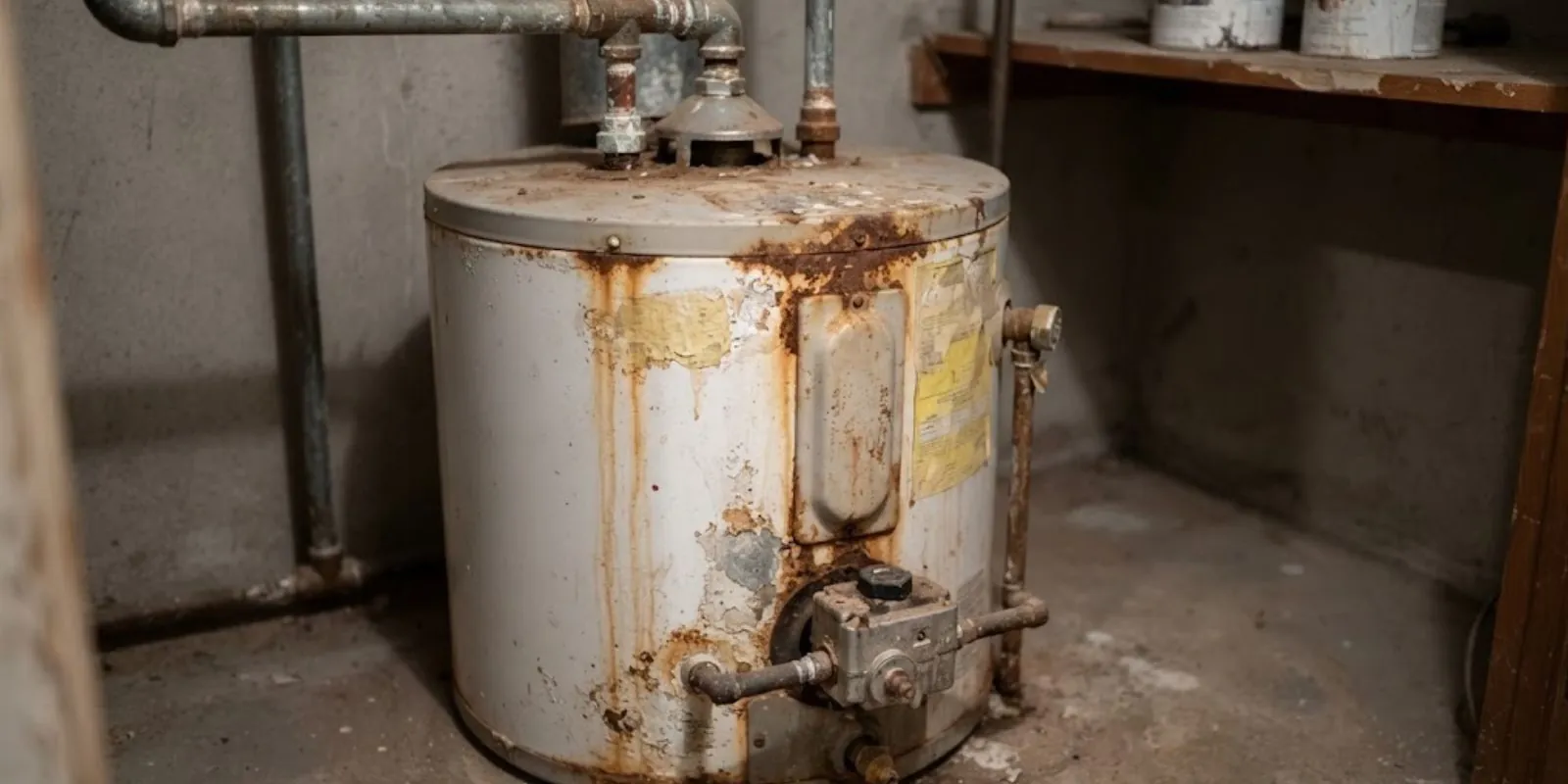
When no hot water is an emergency
Some outages can wait until the morning. These cannot.
- Water at the base of the tankShut the cold supply to the heater and call. Do not wait to see whether it dries.
- A gas smell near the closet or garageLeave the building and call 911 or the gas utility before you call us. A gas leak is never a plumbing appointment to schedule.
- Hot water that is scalding or steaming from tapsA stuck thermostat or a failed valve can push the water well past a safe setting.
- A discharge pipe running continuouslyThe temperature and pressure relief valve is releasing for a reason, and the cause needs finding the same day.
- An older tank in an upper-floor unitAny leak above a neighbor is time-sensitive, even if it looks small.
What actually fails on a gas water heater
On a gas tank, the three common faults are a dirty or failed pilot, a thermocouple or flame sensor that no longer proves the flame, and a gas control valve that has worn out. A pilot that lights and then drops out when you release the button points at the thermocouple. A burner that will not stay lit under load often traces to a partly blocked burner tube or a draft problem in the vent.
Sediment is the other long-term issue. Minerals settle on the tank floor and the burner has to heat through them, which causes popping noises and slower recovery. Flushing helps when the tank is young. On an older tank, a heavy sediment layer often means the lining is near the end.
Electric tanks: elements, thermostats and breakers
An electric tank has two heating elements and two thermostats. If you get lukewarm water, the lower element has often burned out. If you get no hot water at all, the upper thermostat or the high-limit reset button is the first suspect. A breaker that trips again as soon as it is reset usually means an element has shorted to the tank and needs replacing, not resetting.
We test with a meter before changing a part, because swapping an element when the real fault is a thermostat wastes a visit. If the tank has already been leaking at the element gasket, the gasket and element are replaced together.
Symptom guide: what to check and what it points to
Use this as a starting point. A technician confirms the cause on site.
| Symptom | Common cause | Typical repair |
|---|---|---|
| Pilot will not stay lit | Thermocouple or flame sensor | Replace the sensor, clean the pilot assembly |
| Lukewarm water, electric tank | Failed lower element | Replace element, check the thermostat |
| Water runs out too fast | Broken dip tube or heavy sediment | Replace the dip tube, flush the tank |
| Rotten egg smell in hot water | Bacteria reacting with the anode rod | Replace the anode rod, flush and treat |
| Dripping from the discharge line | Thermal expansion or a worn relief valve | Replace the valve, add an expansion tank if needed |
| Rust-colored hot water | Corroded tank or failed anode | Test the tank, usually replacement |
Hybrid, electric and gas units in older West Hollywood buildings
Buildings in West Hollywood that predate July 1979 fall under the city rent stabilization ordinance, and many were built long before efficient water heaters existed. In those buildings the heater often lives in a closet that was sized for a very different appliance. That affects venting, combustion air and how much clearance a new unit needs.
Heat pump and hybrid electric units are becoming common as owners look to cut gas use. They need space and airflow, and the repair path for them involves a compressor and refrigerant circuit that a standard tank repair does not. We tell you early if your unit is better served by its manufacturer or by replacement.
What decides the cost of a repair
The price depends on the part and the access, and you get it before we start.
A thermocouple and a gas control valve are very different jobs.
A repair on a 14-year-old tank is a judgment call, which we will explain honestly.
A closet with limited clearance takes more time.
Common parts are usually on the truck, while specialty controls may need ordering.
Emergency visits outside normal hours are priced as such, and we state that up front.
Insurance generally does not pay for a worn-out part. It may respond to water damage from a sudden leak, so photograph the area before you dry it.
If the repair turns into a replacement
When the tank itself has failed, the answer is water heater replacement, and a unit that is short on capacity may be a candidate for a tankless upgrade. A hot water problem in a shared building often involves commercial plumbing skills too.
Our crews handle heaters in the Hollywood Hills, where closets and garages can make access tight.
Pilot out or tank dripping? Call the line and describe what you see.
Call (213) 672-5590Water Heater Repair questions answered
Yes. The line is open at night and on weekends. If water is leaking, close the cold-water supply to the heater and switch off power or gas. If you smell gas, leave the building and call 911 or the gas utility before calling us. After that, we book the earliest appointment available.
The usual causes are a worn thermocouple, a dirty pilot orifice or a draft pulling the flame off. We replace the sensor and clean the assembly. If the heater is old, we will also check the gas control valve before closing the job.
Flushing is possible for a handy homeowner if the drain valve is in good shape, but old drain valves can clog or leak when opened. If the tank is over about 8 years old, we suggest having a plumber do it so a valve failure does not become a leak.
No. The relief valve is a safety device. Constant dripping means the tank is over pressure or over temperature, or the valve has failed. Have it inspected before the next use.
Yes. We test the elements, thermostats and breaker supply, and we turn off power at the panel first. In a condo, we also confirm with the property manager if the closet is in a shared area.
If the tank is leaking from the shell, or it is past its expected life and needs a major part, replacement usually costs less over time. See water heater replacement for how that decision is made.
Sources and standards
Facts and rules on this page come from the public sources below. Check them for the current wording before you rely on a detail.
- California Plumbing Code (Title 24, Part 5), which is based on the Uniform Plumbing Code (UPC) published by IAPMO.