
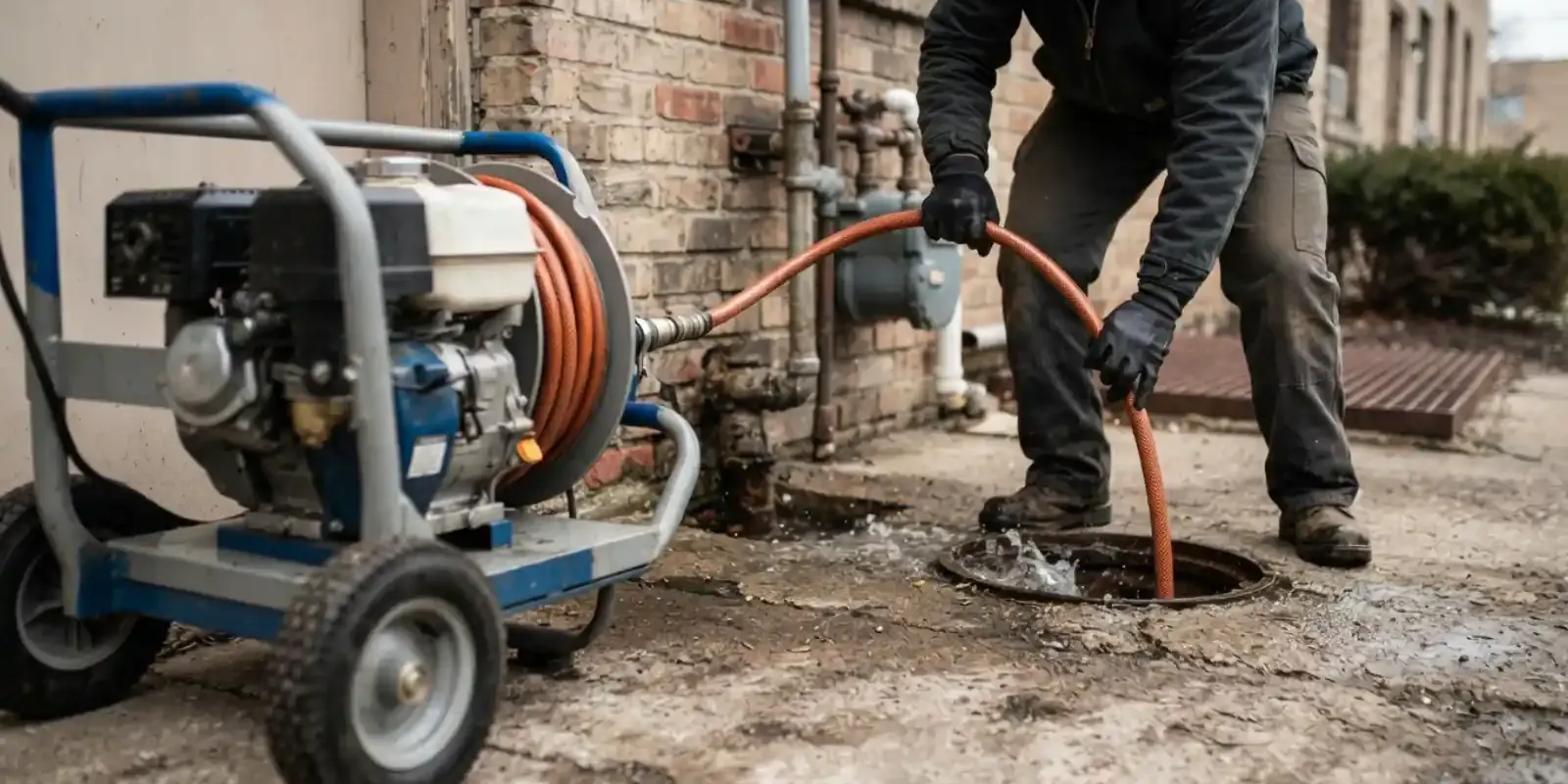
When jetting becomes an emergency job
Jetting is often scheduled, but backups bring it forward. A restaurant line that has filled with grease, a main line full of roots, or a building that backs up every time a few units run water at once are common emergency triggers. The longer sewage sits in a failing line, the more damage it does to floors and finishes.
In busy commercial strips like Santa Monica Boulevard and the Sunset Strip, kitchen lines carry heavy grease loads. A line that is jetted on a schedule rarely turns into a midnight call, which is why many food businesses book recurring service.
How hydro jetting works
A hose with a jetting nozzle is fed into the line through a cleanout. Water at high pressure exits the nozzle in several directions, pushing the nozzle forward and scouring the wall as it returns. The debris flushes toward the sewer, and the pipe is cleaner than any cable can leave it.
We pick pressure and nozzle for the pipe. Cast iron, clay, ABS and PVC tolerate different pressures, and a pipe that is already broken can be damaged by an aggressive jet. That is why a camera inspection is part of the plan whenever the pipe condition is unknown.
Jetting compared with a cable
The two are not rivals. They solve different problems.
| Question | Cable | Hydro jet |
|---|---|---|
| Opens a hole through a clog | Yes | Yes |
| Removes grease from the pipe wall | Rarely | Yes |
| Cuts and flushes root hair | Partly | Yes, with the right nozzle |
| Risk to a cracked pipe | Low to moderate | Higher, camera check first |
| Best for | A single clog | Repeat clogs and heavy buildup |
The sequence of a jetting visit
A good jetting job is planned.
- 1Locate the cleanoutWe find the closest access to the blockage. A missing cleanout can be added.
- 2Camera lookA camera shows the cause and the pipe condition before the jet goes in.
- 3Jet from the downstream sideThe nozzle works toward the clog first, then returns and scours the length of the line.
- 4Confirm flowWater is run to confirm the line drains freely and the camera is used again where the job needs a record.
Roots, grease and scale: what jetting removes best
Grease is the most common cause of repeat kitchen and building-line clogs, and jetting is the most reliable way to remove it. Roots enter a line at joints and cracks. Jetting cuts and flushes hair roots and clears the line, but it does not seal the entry point, so roots tend to return if the joint is not repaired.
Scale and mineral deposits appear in older cast iron, which is common in buildings that predate modern pipe materials. A jet can scour the rough interior surface, and a camera shows whether the pipe underneath is sound or thin.
Where the work happens: private line versus city main
The City of West Hollywood cleans its own sewer mainlines, and property owners maintain the private laterals that connect to them. Work that stays inside the property line can be done by a plumber with a C-36 license. Work in the public right-of-way needs a city encroachment permit and a contractor with an A or C-34 license.
Jetting from a cleanout inside the property is private-side work. If our camera shows the blockage sits in the city main, we tell you and the city handles that part.
What affects the cost of hydro jetting
Pricing is stated before work begins.
A short 3-inch branch and a long 6-inch main take different amounts of time.
A clean outdoor cleanout is faster than working through a fixture.
Heavy roots or scale mean more passes.
A camera pass before and after documents what the jet did.
Restaurants and buildings often book a regular schedule.
Insurance rarely covers the cleaning itself. Sewer backup damage is covered only with a specific endorsement, so check your policy.
Jetting in the wider plan
Jetting works best after a look with a sewer camera, and it often follows a first pass of drain cleaning. If the camera shows a break, the next step is sewer line repair.
We jet restaurant and building lines in Hollywood and along the Sunset Strip.
Repeat clog or heavy buildup? Call and we will plan a camera look and a jet.
Call (213) 672-5590Hydro Jetting questions answered
Yes. Our line is open at night and on weekends. If the main is backing up, stop using water and call. We schedule the earliest available appointment and bring jetting equipment suited to the line size you describe.
On sound pipe, no. On a cracked or deteriorated pipe, high pressure can make a weak spot worse. That is why we camera first when the pipe condition is unknown.
It depends on volume and the grease trap. Many food businesses schedule service quarterly or twice a year. We will suggest an interval after seeing what comes out.
No. Jetting clears roots from the pipe, but if they entered through a cracked joint, they can return. Repair the joint if the camera shows one.
Yes, when there is a cleanout or an access point to the stack or lateral. The property manager should be told because it affects units below.
It shows the interior wall, any cracks, offsets or belly, and whether grease or scale is gone. We use it to decide if the line needs repair.
Sources and standards
Facts and rules on this page come from the public sources below. Check them for the current wording before you rely on a detail.
- California Plumbing Code (Title 24, Part 5), which is based on the Uniform Plumbing Code (UPC) published by IAPMO.
- California Contractors State License Board (cslb.ca.gov) for license checks, license classes, down payment limits and the three-day cancellation rule.
- City of West Hollywood guidance on sewer maintenance, private laterals, encroachment permits and contractor license classes.