
Choose the toilet before you touch anything
Measure the rough-in, which is the distance from the wall to the center of the floor drain. Twelve inches is common, and ten and fourteen exist. A toilet built for twelve will not fit a ten-inch rough-in without a gap.
Pick between one-piece and two-piece, round and elongated bowls, and standard or comfort height. Look for a model with a flush rating that meets current water efficiency rules. Check that replacement parts are easy to find, because a toilet with rare parts is a maintenance problem later.
The installation steps
A proper job follows a fixed order.
- 1Shut off and drainClose the supply valve, flush and sponge out the tank and bowl.
- 2Disconnect and liftRemove the supply line and the bolts, then lift the toilet straight up.
- 3Inspect the flangeCheck that the closet flange is level, solid and at the right height above the finished floor.
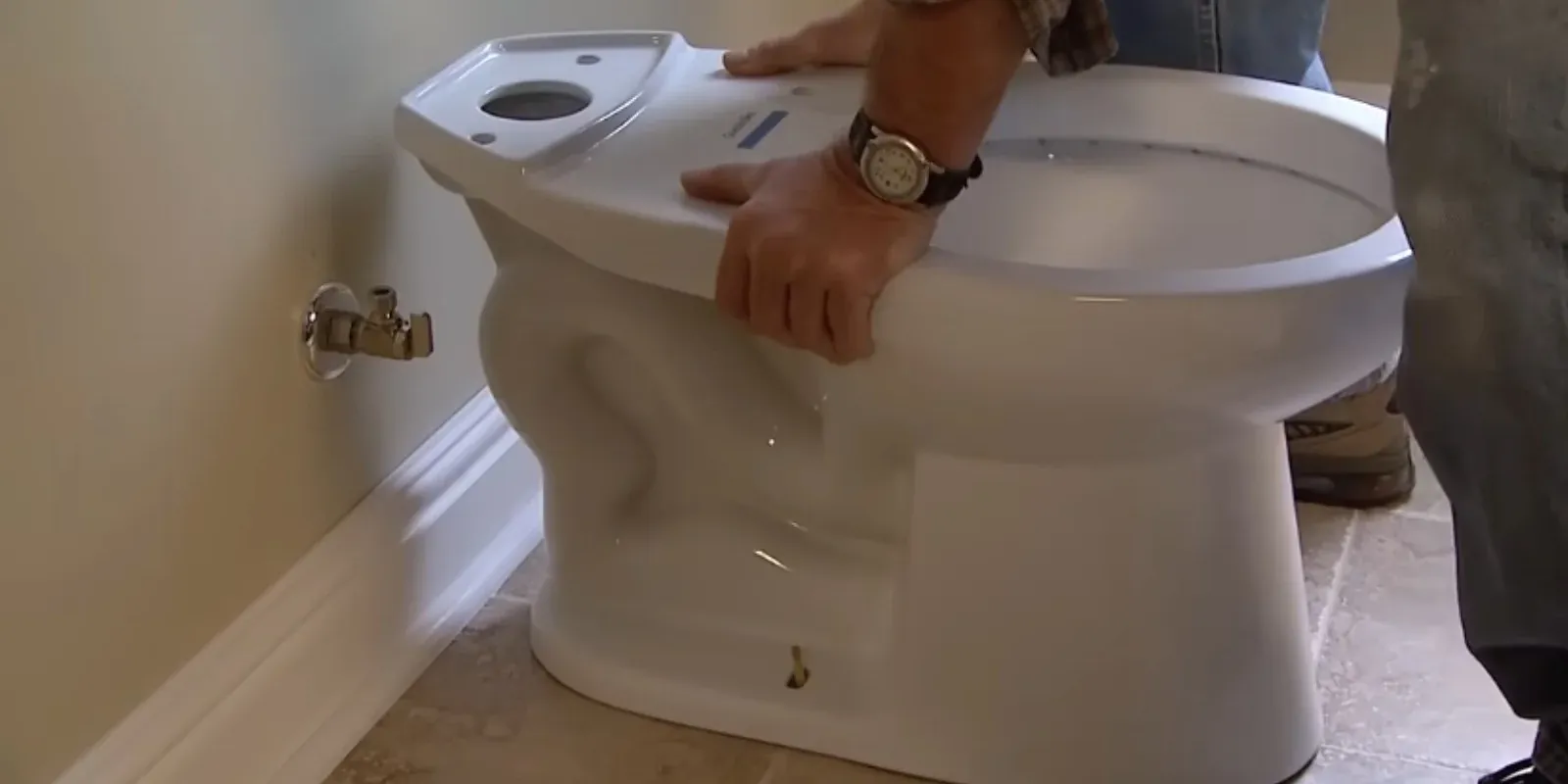
- 4Set the new ring and toiletPlace a fresh wax or wax-free ring and lower the toilet straight down.
- 5Tighten, connect and testTighten the bolts evenly, connect a new supply line, open the valve and check for leaks.
The flange decides whether the job lasts
The flange is the ring on the floor that the toilet bolts to. If it sits below the finished floor, the seal fails. If it is cracked or corroded, the toilet rocks. A repair ring or an extender fixes many cases, and a badly damaged flange needs replacement.
On a wooden subfloor, a soft spot near the flange is a warning of a long-term leak. Replacing wet wood before setting a new toilet saves a second visit.
Wax ring or wax-free: how they compare
Both work when the flange is sound.
| Seal | Strength | Watch for |
|---|---|---|
| Standard wax ring | Low cost, long record | Cannot be reused if the toilet is moved |
| Extra-thick wax ring | Fills a lower flange gap | Not a fix for a badly low flange |
| Wax-free seal | Reusable, cleaner to handle | Needs a level flange |
| Flange extender with ring | Raises a low flange | Needs solid screws into the subfloor |
Supply line and shutoff valve
Replace the supply line every time you replace the toilet. A braided stainless line is a good choice. Check the shutoff valve. If it is stiff, weeping or green with corrosion, replace it now, because it is easy to do with the toilet out of the way.
A valve that will not close is a flood risk. That is also a point where the work moves from a simple swap to a plumbing job, and our plumbing installation page lists the related work.
Before you start
A short list avoids the common surprises.
- Confirm the rough-inMeasure twice before buying.
- Check the shutoff valveMake sure it closes fully.
- Look at the floorSoft wood or loose tile means more work.
- Tell the managerIn a rental or condo, you may need approval.
Setting the toilet without cracking it
Lower the toilet straight down onto the bolts and press it into the seal with your weight, not with force from the side. Tighten the nuts a little at a time, alternating from one side to the other, until the toilet sits solid. Stop when it no longer rocks.
Porcelain cracks under uneven pressure, and a cracked base leaks slowly for months before anyone sees it. Trim the bolts only after the toilet is seated, then cap them. A thin bead of caulk at the front and sides, left open at the back, holds the base in place and lets a future leak show itself.
One-piece, two-piece and wall-hung toilets
The choice changes the install.
| Style | Install notes | Watch for |
|---|---|---|
| Two-piece | Tank and bowl are joined on site | Tank bolts and the tank-to-bowl gasket |
| One-piece | Heavy single unit | Needs two people to lift |
| Wall-hung | Mounted on a carrier inside the wall | Needs a framed wall and a carrier rated for the load |
| Skirted bowl | Smooth sides, hidden trapway | Harder to reach the floor bolts |
Choosing a toilet that will last
Look for a flush system with a large trapway and a rim design that rinses the whole bowl. Check the flush rating on independent tests, since claims on the box vary. A toilet that needs two flushes uses more water than one that works the first time.
Parts matter too. A fill valve and a flapper from a common maker are easy to replace later, and a proprietary assembly is not. Ask what the warranty covers and for how long.
Finally, think about the user. Height, bowl shape and seat size affect comfort, and the right choice for a young family is not always the right choice for an older parent.
What shapes the cost of a toilet installation
We quote before work starts.
Supplied by you or by us.
A repair adds parts and time.
Replacing it adds a small cost and avoids a larger one.
Old toilets are heavy and need hauling.
Tight bathrooms slow the work.
Insurance does not pay for an upgrade. It may pay for water damage if a new toilet fails suddenly, so keep the installer's invoice.
Permits, rentals and what West Hollywood expects
The West Hollywood Plumbing Code requires a permit for installation, alteration, repair, replacement or remodel of a plumbing system. A like-for-like toilet swap in the same place is normally a fixture replacement, while moving a toilet or changing drain piping is a permit matter. Ask the Building and Safety Division if your job is unclear.
California requires a licensed contractor for work of a labor-and-materials value above the state threshold, and it is smart to confirm a plumber's license on the state board site. In a rented unit, the owner generally decides on fixture replacement, so ask before you buy a toilet. For related work, see toilet repair, the Hollywood service page and the Beverly Hills service page.
Local questions answered
A straightforward swap takes a short visit. A damaged flange or a rotted subfloor adds time.
A like-for-like swap is usually a fixture replacement. Moving the toilet or changing drain pipes needs a permit.
No. A wax ring seals once. A new ring or seal goes in every time the toilet is lifted.
It depends on the HOA rules. Check before you buy, especially for work that touches shared pipes.
Sources and standards
Facts and rules on this page come from the public sources below. Check them for the current wording before you rely on a detail.
- California Plumbing Code (Title 24, Part 5), which is based on the Uniform Plumbing Code (UPC) published by IAPMO.
- West Hollywood Plumbing Code section 103.1.1, permits for plumbing installation, alteration, repair, replacement and remodel, and the exemptions for leak repair and clearing stoppages.
- California Contractors State License Board (cslb.ca.gov) for license checks, license classes, down payment limits and the three-day cancellation rule.
Got a plumbing problem in West Hollywood? Call the line.
Call (213) 672-5590