
Three different problems, three different tools
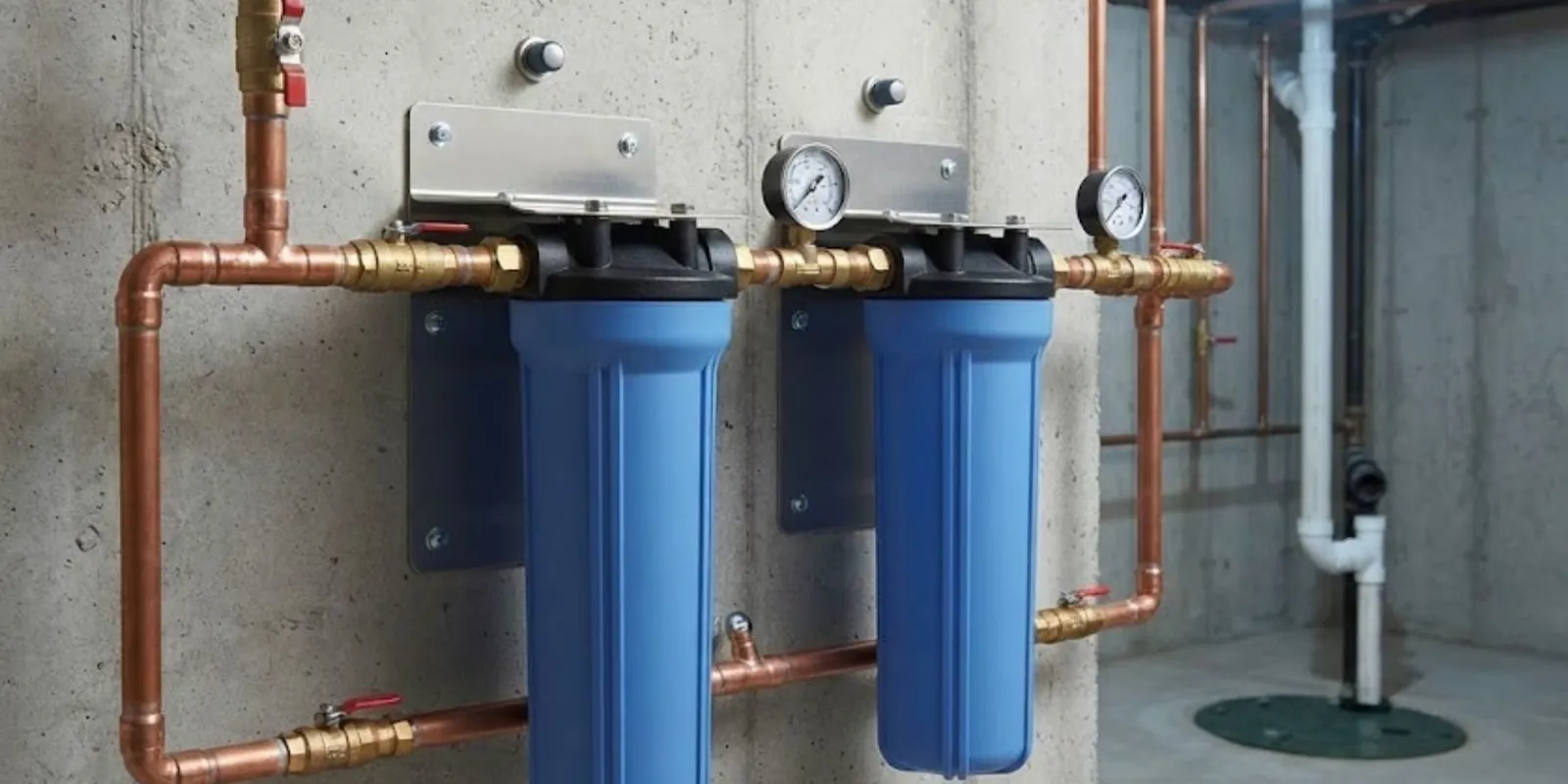
Sediment filters catch sand, rust flakes and debris. Scale inhibitors reduce how minerals stick to surfaces. Softeners remove hardness minerals from the water. They are not interchangeable, and a sediment filter does nothing about hardness.
Before you buy anything, find out what your water carries. Your utility publishes a water quality report, and a simple hardness test strip at the tap gives a quick answer. Then pick the tool that fits the problem.
Filter and treatment types compared
Each one handles a different problem.
| Type | What it does | Limits |
|---|---|---|
| Sediment filter | Catches particles | Does not reduce hardness |
| Scale inhibitor cartridge | Reduces scale formation | Needs regular replacement |
| Water softener | Removes hardness minerals | Needs space, salt and drain, see softener and filtration |
| Carbon filter | Reduces chlorine and chloramine taste | Does not stop scale |
Descaling and flushing
Most manufacturers call for an annual flush where the water is hard. A pump circulates a descaling solution, usually vinegar or a purpose-made liquid, through the heat exchanger for a set time. Then the unit is rinsed. Skipping this in a hard water area is the common reason tankless units fail early.
A service visit also checks the inlet screen, the venting, the gas connections and the error history. We cover installation and replacement on the tankless water heater page.
Signs your tankless unit needs attention
Do not wait for a failure.
- Fluctuating hot waterScale restricts the heat exchanger.
- Error codesMany relate to flow, temperature or ignition.
- Reduced flowThe inlet screen or the exchanger is clogged.
- Strange noisesScale boiling in narrow passages.
Installing a filter in the right place
A sediment filter goes on the cold supply before the heater, with isolation valves so it can be changed without shutting the building. A scale inhibitor sits there too. A softener treats the entire building supply, and it needs a drain and an electrical outlet.
Condos and apartments often cannot fit a whole-building system. In that case a point-of-use setup at the heater, with isolation valves and a flush port, is the practical choice. The flush port also makes the annual service faster.
How to flush a tankless unit, in plain steps
Close the gas and the cold supply to the unit, then connect hoses to the service valves on the hot and cold sides. A small pump pushes descaling solution from a bucket through the unit and back again. Forty-five minutes to an hour is the typical run, followed by a clean water rinse.
Clean the inlet screen while the unit is open, since a clogged screen mimics scale. Many owners skip the flush because it looks fussy. Installing service valves when the unit goes in makes the job quick for a plumber and possible for an owner.
What a service visit should include
Ask for each item by name.
- Flush with descaling solutionRun for the time the manufacturer states.
- Inlet screen cleaningCheck for debris.
- Vent and combustion checkA blocked vent is a safety risk.
- Error history reviewRepeated codes point to the next failure.
- Written note of settings and findingsYou need it for warranty proof.
Matching the filter to what your tap runs
Run a test strip at the hot tap and read your utility report before choosing a filter. If the report shows high hardness, a softener or a scale inhibitor is the answer. If you taste chlorine or chloramine, carbon is the answer. If you see sand or rust flakes, a sediment filter is the answer.
Many buildings need more than one. A sediment filter ahead of a scale inhibitor is a common pair, with a carbon filter at the kitchen tap for drinking water. Each step has its own replacement schedule, so write the dates on the housings.
Resist the urge to buy the biggest system. A well-matched small one beats an oversized one that no one maintains, and a unit that is easy to service gets serviced.
Costs of ignoring the water
A tankless unit that scales up loses efficiency first, then flow and then the heat exchanger. Replacement of an exchanger or the whole unit is far more than a year of filters and flushes. Warranty claims can also be denied when records show no maintenance.
The least costly approach is a steady one: test the water, pick a matching treatment and flush on schedule. Put the dates on your calendar the day the unit is installed, and ask your plumber to leave service valves in place.
If you inherited a unit in an older building, have it inspected before the first winter of heavy use, since an unknown service history is the main risk.
What shapes the cost of tankless filtration and service
Get a written price.
Cartridges, softeners and flush kits differ.
Isolation valves and a flush port add parts.
Harder water means more frequent service.
Annual descaling is a recurring cost.
An older heater may be near replacement, see water heater replacement.
Warranty rules matter. Many manufacturers require proof of regular maintenance. Keep your service records.
Hardness values in West Hollywood and Beverly Hills
LADWP serves most of West Hollywood. Its 2023 water quality tables list total hardness by source, with values that run from the mid fifties to over two hundred mg/L, and which source reaches your tap depends on where you live and the time of year. Beverly Hills Water serves certain areas on the west side, and the city reports about 290 mg/L, or roughly 17 grains per gallon, with chloramine disinfection.
That means a tankless unit in one building can see far harder water than a unit a few blocks away. A hardness test at your own tap is the only reliable answer. Our Beverly Hills page and the Hollywood Hills page explain how water and pressure differ by area.
Local questions answered
Not all. It depends on water hardness and the manufacturer. In a hard water area a scale control step is wise.
Many manufacturers say once a year in hard water. Check the manual for your model.
No. It catches particles. Hardness needs a softener or a scale inhibitor.
Usually not, and poor water quality can void it if it causes damage. Read the warranty.
Sources and standards
Facts and rules on this page come from the public sources below. Check them for the current wording before you rely on a detail.
- California Plumbing Code (Title 24, Part 5), which is based on the Uniform Plumbing Code (UPC) published by IAPMO.
- City of Beverly Hills water quality information and the LADWP 2023 water quality report, which list hardness and disinfection by source.
Got a plumbing problem in West Hollywood? Call the line.
Call (213) 672-5590