
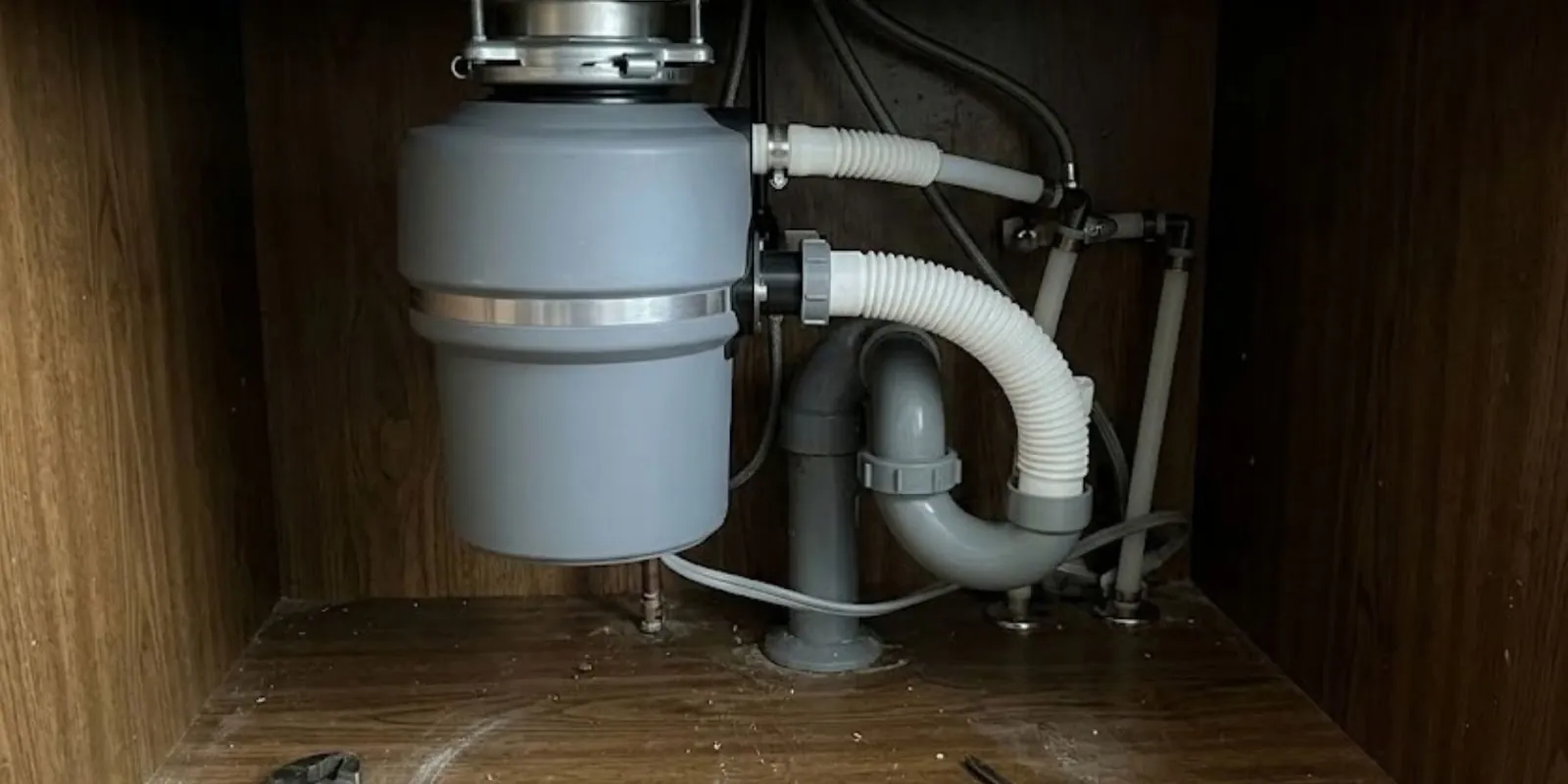
Three things to confirm before you buy
First, the sink. A disposal fits a standard three-and-a-half or four-inch drain opening, and a sink with no opening or a very thin one needs different parts. Second, the power. A disposal needs a switched outlet or a hardwired connection. Third, the drain. A disposal sends solids into your trap and branch line, and a slow line gets worse.
If the kitchen has an old branch line, consider a camera look or a cleaning first. We cover that on the drain cleaning page.
Disposal types compared
Pick for how you cook.
| Type | Best for | Notes |
|---|---|---|
| Continuous feed | Most homes | Runs while the switch is on |
| Batch feed | Safety-minded households | Runs only with the stopper in place |
| Higher horsepower | Heavy use | Costs more and is heavier |
| Lower horsepower | Light use | Jams more with fibrous food |
Installation steps
A methodical sequence keeps leaks away.
- 1Shut off power and waterSwitch off the breaker and close the valves.
- 2Remove the old unit or the sink strainerTake out the mounting assembly.
- 3Mount the flange and the unitSeat the flange with plumber putty and secure the mounting ring.
- 4Connect the drain and the dishwasherAttach the discharge pipe and the dishwasher inlet, with the knockout plug removed if a dishwasher connects.
- 5Wire and testConnect power, run water and check every joint.
The dishwasher knockout and the air gap
Many disposals have a small plug in the dishwasher inlet. If a dishwasher connects, that plug must be removed or the dishwasher will not drain. Missing this step is a common installation mistake, and it shows up as a dishwasher that fills with dirty water.
Check how your dishwasher drain is routed. Some jurisdictions require a high loop or an air gap so wastewater cannot flow back. Your plumber knows the local requirement.
Common mistakes
These cause most return visits.
- Skipping the knockoutThe dishwasher will not drain.
- Too little puttyThe flange leaks under the sink.
- Loose mounting ringThe unit vibrates and leaks.
- Wrong wiringA safety risk and a code issue.
Electrical: switched outlet, cord or hardwire
A disposal needs its own switch, usually on the wall above the counter. Many are plug-in units that use a standard outlet under the sink, often wired so a wall switch controls it. Others are hardwired into a junction box. Either way, the circuit must handle the load.
If there is no switch or no outlet, an electrician needs to add one. We can tell you what is needed, though the electrical work itself is a separate trade. A wrong wiring job is a fire and shock risk, and it is not the place to save money.
Dishwasher drain and the high loop
A dishwasher drains into the disposal inlet or into the sink drain. The drain hose should rise in a high loop under the counter before it reaches the disposal, so dirty water cannot flow back into the dishwasher. A hose that sags is a common cause of dishwasher smells.
After installation, run the dishwasher and watch the connection. A leak at the clamp shows up at once, and a slow drain shows that the knockout plug is still in place.
A first-day checklist after installation
Run through these in order.
- Run cold water and the unit for fifteen secondsListen for grinding or rattling.
- Check every joint under the sink with a dry paper towelA dry towel shows a slow drip.
- Run the dishwasherConfirm it drains.
- Check the reset buttonNote where it is for later.
Choosing horsepower and features without overspending
A half-horsepower unit suits one or two people who cook lightly. Three-quarters to one horsepower suits a household that cooks daily. Stainless grinding parts last longer than galvanized ones, and extra sound insulation makes a small kitchen quieter.
Do not buy for the largest meal of the year. A disposal is a convenience for scraps, not a trash can, and the right unit is the one you will use gently. Check the mounting type too, since quick-lock systems fit most sinks and simplify the next replacement.
Ask whether the unit comes with a cord and a mounting gasket. Missing parts are a common reason an installation takes a second visit.
When to hire a plumber instead of doing it yourself
A swap of one disposal for another of the same type is a reasonable weekend job for a handy owner. A first-time installation, a new electrical connection or a sink with an odd drain is better left to a plumber.
The risk is in the small things: a flange that leaks, a dishwasher line that was not reconnected and a wiring error under a wet sink. A short professional visit includes testing, and it gives you a person to call if something drips later.
What shapes the cost of installing a disposal
A price should be clear first.
Horsepower and features change the price.
A new switched outlet adds a step.
A slow branch line may need cleaning.
Some sinks need extra parts.
Hauling is part of the job.
Insurance does not cover an upgrade. It may cover water damage from a sudden leak.
Kitchens in rentals, condos and older West Hollywood buildings
West Hollywood is mostly renters, so many kitchens already have a disposal or the wiring for one. If you rent, ask the owner before installing anything, since a disposal is an alteration. In a condo, the HOA rules may restrict disposals because they put more load on a shared line.
Older kitchens often have a long horizontal branch that serves several units, and that is where grease collects. Without a clean line, a new disposal will not fix a clog. If a kitchen branch has trouble, see garbage disposal repair and the Hollywood page, or the Hollywood Hills page for houses on the hills.
Local questions answered
A switched outlet or a hardwired connection is needed. An electrician may be required.
Septic homes usually avoid them. Most West Hollywood buildings are on the sewer, so this is rarely an issue.
It can, when grease and fibrous food go in. Use cold water and cut scraps small.
A swap takes a short visit. A new installation with electrical work takes longer.
Sources and standards
Facts and rules on this page come from the public sources below. Check them for the current wording before you rely on a detail.
- California Plumbing Code (Title 24, Part 5), which is based on the Uniform Plumbing Code (UPC) published by IAPMO.
Got a plumbing problem in West Hollywood? Call the line.
Call (213) 672-5590